
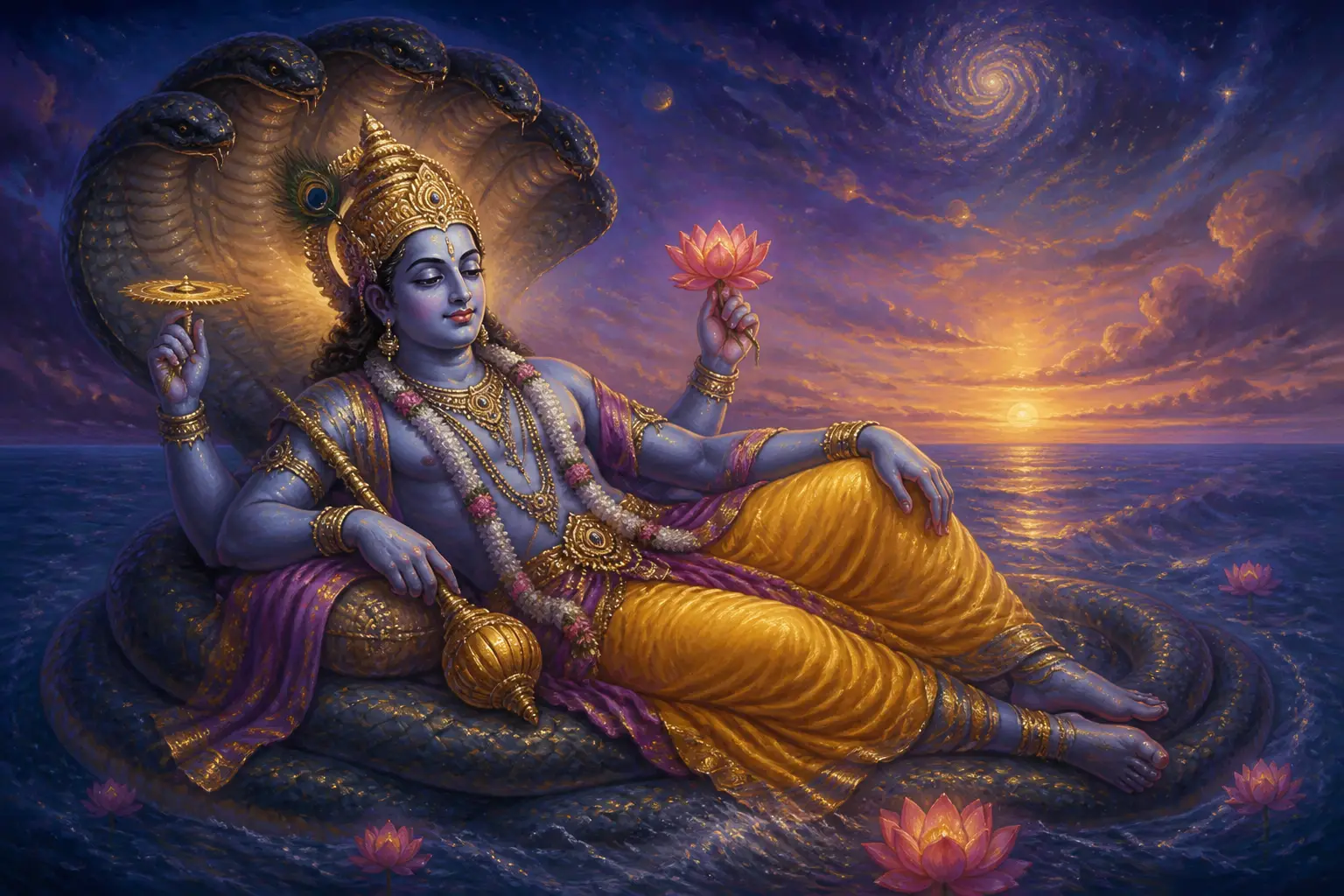
Katha grantha
Vishnu Katha
विष्णु कथा
Descents, dharma fields, and four corners of the peninsula
Vaishnava chapters for Dashavatara literacy and Char Dham as real places. For Marathi pothi depth open /harivijay and /ramvijay.
Chapter 1
Why the Absolute descends
अवतार
Avatāra means descent. In Vaishnava theology, when dharma thins, Viṣṇu takes forms the world can meet: fish and tortoise of cosmic rescue, man-lion of threshold justice, dwarf of measured asking, Rama of maryādā, Krishna of intimate play and hard teaching.
Lists of ten vary slightly — Balarāma or Buddha appear in different classical enumerations. The point is not a zoology quiz. The point is that transcendence refuses to abandon history’s mess.
Read the Gītā not as a motivational poster but as a conversation on a battlefield about duty, grief, and the self that is not killed when bodies fall. Then the avatāra stops being a comic-book power-up.
- Classical Dashavatara lists (tradition)
- Bhagavad Gita within Mahabharata (itihasa)
Ask about this section
Vishnu Katha · Why the Absolute descends
Names the people and the event in this section, then says what the page does not include. It will not invent missing verses.
Chapter 2
Two childhoods, two ethics
राम · कृष्ण
Rama’s birth in Ayodhya is told as the arrival of Maryāda Puruṣottama — the person who keeps the measure. Exile, forest, war, and return become a public curriculum of promise-keeping. Diwali lamps in many homes remember that return.
Krishna’s birth in a prison, the Yamuna crossing, butter thefts, and the Kurukshetra discourse form another curriculum: intimacy and toughness braided. Janmashtami’s midnight cradle is not only cute — it is the claim that the Absolute enters risk.
Onam’s Mahabali story and Vamana’s three steps remind South India that generosity and cosmic order can argue inside one festival table.
- Valmiki Ramayana; Bhagavata Purana (tradition)
- Hind AI festival pages: Rama Navami, Janmashtami, Onam, Diwali
Ask about this section
Vishnu Katha · Two childhoods, two ethics
Names the people and the event in this section, then says what the page does not include. It will not invent missing verses.
Chapter 3
Four corners you can walk
चार धाम
Badrinath, Dwarka, Puri, and Rameswaram mark a Vaishnava map of the peninsula. Later memory ties the circuit to Adi Shankara; each temple keeps its own rebuilds, kitchens, and crowd sciences.
Puri’s ratha gave English the word juggernaut — a reminder that Indian ritual entered world language as living force, not as museum dust.
Ekadashi fasting twice a month is the quiet drum under the famous festivals. If you only visit Char Dham once, still keep one ekadashi as a listening day for the Gītā or a name of Viṣṇu.
- Char Dham pilgrimage geography
- Living ekadashi custom in Vaishnava homes
Ask about this section
Vishnu Katha · Four corners you can walk
Names the people and the event in this section, then says what the page does not include. It will not invent missing verses.