
WWDC26 (week of June 8, 2026) finally put a sharper name on the bet Apple has been making for two years: intelligence that feels like OS verbs, not a chat personality bolted onto every screen. Apple’s public materials introduce Siri AI as a substantially more capable Siri powered by the next generation of Apple Intelligence, alongside iOS/iPadOS/macOS/watchOS/visionOS/tvOS 27 previews and continued Liquid Glass work.
I am not reprinting the keynote. I am extracting the developer contract: what you should model, what you should confirm, and what you should refuse to automate.
Reader promise: You will see what developers should expose to Siri AI: entities, schemas, confirmations, and calm automations—grounded in Apple’s public WWDC26 materials, not invented APIs.
Fast Context
Three threads matter for builders:
1. Siri AI as a system client — personal context, onscreen awareness, web knowledge, and systemwide app actions, with a dedicated Siri app for conversation history (iCloud-synced, per Apple). 2. App Intents / App Schemas — the durable API. Model entities, adopt schemas, index for Spotlight, test with App Intents Testing. Natural language is Siri’s problem; your problem is typed content and actions. 3. Liquid Glass maturation — introduced at WWDC25; WWDC26 materials emphasize personalization (for example, a Settings slider from clearer to more tinted) and craft over glitter.
TL;DR
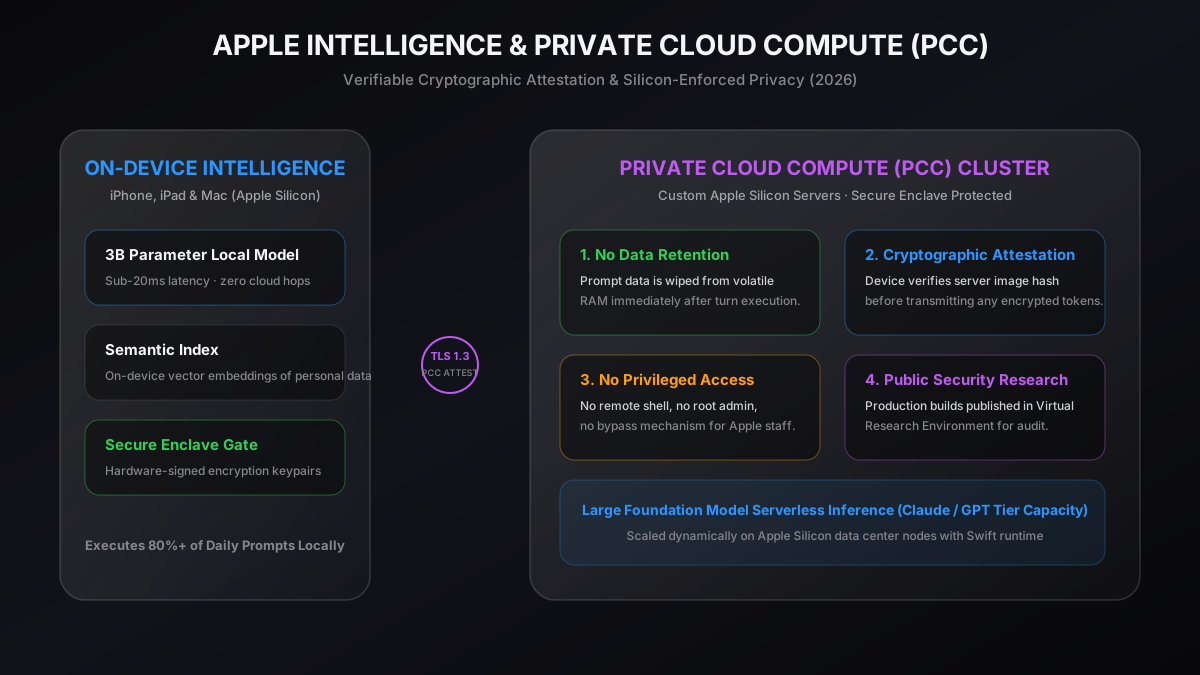
The Apple Intelligence opportunity is not another assistant panel. It is entity + intent design, privacy-aware context, and small automations that feel like part of the OS. On-device work remains the right default for private low-latency tasks; Private Cloud Compute is an extension path whose credibility depends on observable boundaries. Siri AI needs reliability more than novelty. Liquid Glass year-two work should improve legibility, contrast, and performance—not only specular shine.
Liquid Glass: Year-Two Engineering Questions
When a design language ships, the second year is where craft shows:
- Do translucent materials preserve contrast for accessibility and Dynamic Type?
- Do animations stay within energy and thermal budgets on older supported devices?
- Are component kits consistent across system apps and third parties?
- Does personalization (tint/clear controls) help users, or fragment visual hierarchy?
My read: Liquid Glass succeeds if it becomes quiet infrastructure—clarity users feel—not a permanent keynote aesthetic demo.
Maturation is mostly systems quality, not more chrome. Scores are my judgment.
Siri AI: Product Constraints as Features
Personal context with attribution
Apple’s pitch is that Siri can search across messages, mail, photos, and more, answer about onscreen content, and take actions across apps. The engineering corollary for third parties is Spotlight indexing and entity modeling—so answers can attribute content back to your app instead of hallucinating a shadow database.
Private Cloud Compute as extension, not slogan
Heavier reasoning may leave the device under Apple’s private cloud patterns. Messaging must match architecture: what is sent, how it is processed, what is retained. Footnotes about region and language availability are part of the product, not fine print to ignore.
App Schemas as the real API
If Siri can only generate text about your app, you built a brochure. If it can perform structured actions—create item, search entity, start workflow—you built a platform citizen. WWDC26 developer sessions emphasize schemas, domains, Transferable content, and progressive testing (App Intents Testing → Shortcuts → Spotlight → Siri).
What Developers Should Expose
Start with five high-confidence intents:
1. Search projects / records 2. Summarize recent work (with source pointers) 3. Create a reminder or follow-up 4. Open a canonical detail view 5. Prepare a draft (email, message) without auto-send
Each action needs a predictable input schema, reversible output where possible, confirmation when user data changes, and clear permission copy. Index entities so semantic search has something real to retrieve.
What I Would Watch
- Siri reliability regressions that train users to avoid voice
- One giant “do anything” intent instead of schema domains
- Translucent UI that fails contrast under real wallpapers
- Privacy claims without observable boundaries in Settings
- Features that break Focus modes, offline mode, or enterprise MDM constraints
- Shipping “available this fall” language as if it were already on every device and locale
The Workflow I Would Use
1. Inventory user tasks already completed by taps. 2. Model those as App Entities + intents; adopt matching App Schema domains where they fit. 3. Index for Spotlight; add onscreen awareness annotations where “this/that” references matter. 4. Decide on-device vs cloud per task with a written data boundary. 5. Add confirmation for create/update/delete. 6. Test with App Intents Testing first, then Shortcuts, Spotlight, and Siri. 7. Verify Liquid Glass/UI states for light, dark, high contrast, and Dynamic Type.
Things I Learned
- The best Apple Intelligence feature may look like a normal button, shortcut, or suggestion.
- Structured app actions are easier to trust than open-ended automation.
- A premium AI experience should feel calm, reversible, and explainable.
- Design language maturation is an engineering project, not only branding.
How I Would Apply This
For an iOS or portfolio companion, I would expose small, high-quality intents instead of one broad assistant. The system should know exactly what it can do and when it must ask first. Visually, I would implement Apple-like materials with accessibility budgets, not uncritical glass everywhere.
Apple Developer — WWDCBottom Line
Apple’s AI strategy is about making intelligence part of the system contract. Developers who expose high-quality entities and actions will get more value than those who add a chat box. Liquid Glass should mature into clarity. Siri AI should mature into trustworthy verbs—or users will quietly stop asking.
Sources
- Apple Newsroom: next generation of Apple Intelligence and Siri AI
- Apple Newsroom: Siri AI introduction
- WWDC26 — Build intelligent Siri experiences with App Schemas
- WWDC26 Apple Intelligence guide
- Liquid Glass introduced in the WWDC 2025 timeframe; confirm year-two UI details against current HIG and release notes before citing specific controls