
4 billion payments. 3 trillion data points. One foundation model trained on all of it.
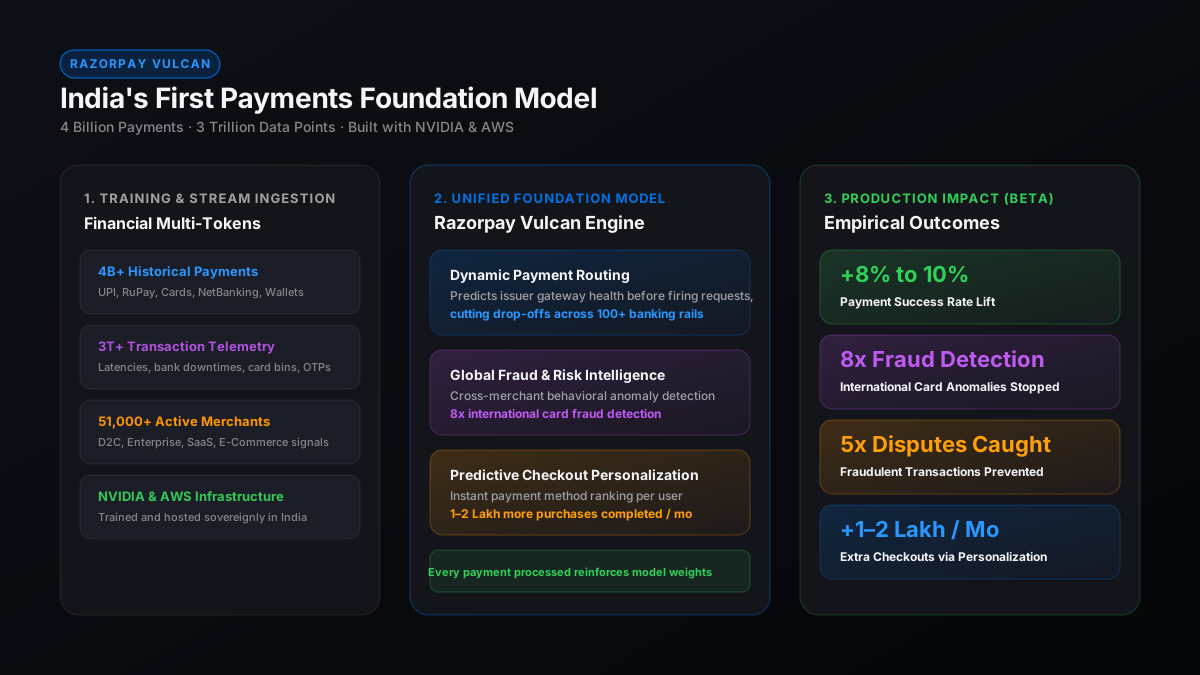
In August 2026, Razorpay unveiled Vulcan—India’s first transformer-based AI foundation model purpose-built for the financial transaction ecosystem. Built, trained, and hosted sovereignly in India in strategic partnership with NVIDIA and AWS Cloud, Vulcan fundamentally rethinks payment processing from fragmented rule heuristics into a single, unified intelligence layer.
Reader promise: You will understand how Razorpay tokenized 4 billion payment transactions, how Vulcan unifies fragmented routing, fraud, risk, and checkout personalization into a single foundation model, and the systems engineering behind financial transformers.
Fast Context
Until now, the fintech industry addressed payment challenges through isolated, specialized subsystems: - A heuristic algorithm for gateway routing (e.g. switching between HDFC, ICICI, Axis, or SBI based on error code averages). - A separate scoring engine for fraud and risk detection (e.g. velocity limits, IP geolocation checks). - An independent recommendation system for checkout payment method sorting (e.g. showing UPI vs Credit Card).
Razorpay asked a foundational question: What if one model could understand how money moves?
Just as Large Language Models (LLMs) are trained on trillions of text tokens to understand human syntax and semantics, Vulcan is trained on financial transaction tokens to understand the physics of money flow.
Razorpay Vulcan AI Foundation ModelTL;DR & Production Beta Outcomes
Already operating in production beta across 51,000+ businesses, Vulcan is delivering extraordinary, empirically verified results: - +8% to 10% improvement in payment success rates—the ultimate benchmark of whether a transaction completes smoothly. - 8x more international card fraud detected across cross-border e-commerce rails. - 5x more fraudulent or disputed transactions identified before chargebacks occur. - 1–2 lakh additional purchases completed every month through real-time checkout personalization. - Self-Reinforcing Flywheel: Every single transaction Vulcan processes reinforces model weights, making subsequent routing decisions faster and smarter.
Architectural Breakdown: How Vulcan Tokenizes Financial Flow
┌────────────────────────────────────────────────────────┐
│           1. MULTIMODAL TRANSACTION TOKENIZATION       │
│  UPI VPA · Bank BIN · Device Fingerprint · Merchant Cat │
└───────────────────────────┬────────────────────────────┘
                            │ Sub-Millisecond Feature Vector
┌───────────────────────────▼────────────────────────────┐
│             2. VULCAN TRANSFORMER CORE (NVIDIA)         │
│  Multi-Head Temporal Attention · Cross-Entity Dynamics │
└───────────────────────────┬────────────────────────────┘
                            │ Unified Inference Vector
┌───────────────────────────▼────────────────────────────┐
│             3. MULTI-TASK PREDICTIVE HEADS             │
│  [Dynamic Route]  ──  [Fraud Risk]  ──  [Personalize]  │
└───────────────────────────┬────────────────────────────┘
                            │ Direct Execution
┌───────────────────────────▼────────────────────────────┐
│             4. 51,000+ BUSINESSES (PRODUCTION)         │
│  8–10% Success Rate Lift ── 8x Fraud Stop ── +2L Sales │
└────────────────────────────────────────────────────────┘
1. Tokenizing the Anatomy of a Payment
Language models treat words as subword tokens. Vulcan tokenizes payment sequences into dense multi-dimensional embeddings: - Temporal Tokens: Timestamp, day-of-week cadence, banking holiday states, and real-time network traffic congestion. - Entity Tokens: Card Issuer BIN, Acquiring Gateway, UPI Handle (VPA), Merchant Category Code (MCC), and device platform. - Behavioral Velocity Tokens: User transaction frequency, cross-merchant spending patterns, and OTP delivery latency windows.
By feeding these sequences into a transformer with multi-head attention, Vulcan discovers non-obvious correlations: for instance, predicting that an issuing bank's OTP service is degrading in a specific telecom circle before the bank returns HTTP 500 error codes, dynamically shifting user traffic to alternative payment rails.
2. Unifying the Payments Stack
Instead of executing five sequential API hops (fraud check → risk check → personalization → routing → 3DS), Vulcan computes a unified forward pass in under 15 milliseconds:
3. Sovereign AI Infrastructure in India
Financial transactions carry strict sovereign regulatory requirements under Reserve Bank of India (RBI) guidelines. Razorpay built, trained, and hosts Vulcan entirely within Indian data centers in collaboration with NVIDIA (leveraging GPU acceleration for distributed training and TensorRT-LLM for low-latency inference) and AWS Cloud India.
Production beta metrics verified across 51,000+ live enterprise and SMB merchants.
What I Would Watch Closely
Model Drift vs Sudden Banking Infrastructure Flips. When a major bank conducts scheduled core banking system (CBS) maintenance at midnight, historical tokens may mispredict gateway availability. Vulcan combines foundation model inference with real-time circuit breakers to prevent routing loops.
False Positive Mitigation in High-Value Orders. Increasing fraud detection by 8x requires careful calibration to ensure legitimate high-ticket luxury or B2B transactions are not inadvertently blocked.
Edge Deployment on Mobile SDKs. Delivering sub-15ms checkout personalization on 4G/5G mobile networks in Tier-2 and Tier-3 Indian cities requires highly optimized quantized weights (INT8/FP8) embedded within the Razorpay standard checkout script.
The Architecture Pattern for Fintech Builders
For engineers designing AI-native transaction systems:
1. Unify the Data Plane: Ingest payment metadata, banking telemetries, and user interactions into a single streaming vector bus (Kafka/Kinesis). 2. Train for Multi-Task Prediction: Structure the transformer with multiple output heads sharing the same foundational representation (routing, fraud, checkout ranking). 3. Strict Latency Budget: Cap model inference at ≤ 15ms to ensure zero perceived checkout lag. 4. Close the Feedback Loop: Automatically label transaction outcomes (settled, failed, chargeback) to continuously fine-tune model weights.
Bottom Line
Razorpay Vulcan demonstrates that foundation models are not limited to text and images. By training India's first payments transformer on 4 billion transactions and 3 trillion data points, Razorpay, NVIDIA, and AWS have constructed the intelligence layer for the future of digital commerce.
Sources and further reading
- Razorpay Vulcan Official Announcement — foundation model specifications, enterprise beta features, and partner integration notes
- Razorpay Engineering Blog — deep dives into real-time transaction processing and payment success rate optimization
- NVIDIA AI & Financial Services — GPU-accelerated training architectures and TensorRT inference in fintech
- AWS Cloud India FinTech Solutions — sovereign cloud infrastructure and regulatory-compliant AI hosting