
In 2026 the hard problem is rarely "can I call a model?" It is "can I keep calling useful models when prices move, providers flake, caches miss, and geopolitics reshapes token share?" OpenRouter increasingly feels like a USB hub for intelligence: one plug shape, many devices behind it, and a routing policy that decides which cable actually carries power.
Reader promise: You will get a concrete routing policy—primary, fallback, free-chain, and sticky sessions—instead of another model beauty contest.
Fast Context
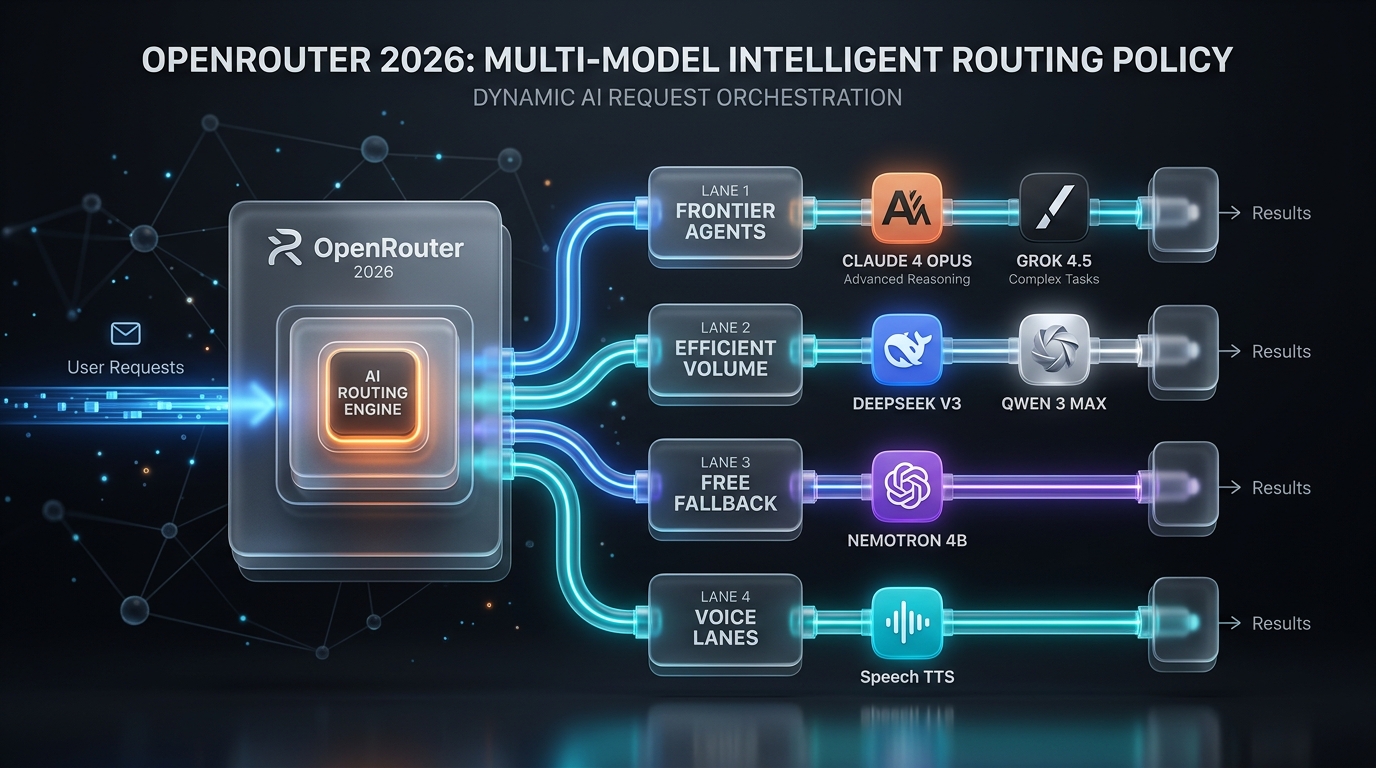
OpenRouter is an OpenAI-compatible gateway: one API surface, many model slugs, provider-side fan-out, and controls for price, throughput, allowlists, and session stickiness. That matters more as the market fragments. OpenRouter enterprise routing data through mid-2026 showed Chinese-origin models holding at least ~30% of weekly US enterprise token volume every week since February 8, 2026, with peaks near 46%—up from roughly 4.5% in H1 2025 and ~11% averaged over the prior year. DeepSeek-class and Qwen-class routes are not a footnote; they are load-bearing capacity for cost-sensitive products. (Industry coverage, including CNBC on July 7, 2026, later summarized the same OpenRouter traffic picture; verify the latest weekly series before citing in investor materials.)
Meanwhile frontier models (Grok 4.5, GPT-class, Claude-class, Gemini-class) still win many hard agent turns. The builder job is not to pick a tribe. It is to write a routing policy that matches task class to model class, then enforce it in code.
AssistMe on this portfolio already lives in that world: OpenRouter for LLM and TTS paths, Fusion/Auto-style routing experiments, Nemotron free-chain fallbacks, and server-pinned credentials so browsers never see keys.
OpenRouter Auto RouterTL;DR
Treat OpenRouter as infrastructure, not as a model. Define lanes: frontier primary for hard agent work, efficient open models for volume, free/cheap chain for offline-feel UX when credits die, and sticky sessions whenever prompt caching matters. Pass session_id (or x-session-id) so sticky routing activates early. Pin providers when quality varies across hosts for the same slug. Measure cache hit rate and provider flips the same way you measure p95 latency.
What Actually Shines
1. One integration, many brains
A single OpenAI-compatible client can reach Grok, Claude, GPT, Gemini, DeepSeek, Qwen, and free-tier options without rewriting transport code. For a FastAPI + Worker portfolio, that is the difference between shipping AssistMe and maintaining five SDKs.
2. Provider diversity behind one slug
"DeepSeek" is not one machine. OpenRouter's own writing notes many companies serving the same family at different price and throughput points. Controls like sort by throughput/price, max_price, order / only / ignore, and quantization filters turn that mess into an operable system.
3. Sticky routing + prompt caching as a pair
Cache reads are often a fraction of input price (provider-dependent; Grok cache reads are documented around 0.25x input on OpenRouter's caching notes). Sticky routing exists so follow-up turns can keep hitting a warm provider cache. Without a session_id, stickiness may only engage after a cache hit is detected—and can flip after idle gaps. That is not a bug report. It is a policy input.
Weights are operational priorities for a dual-host portfolio assistant, not a vendor ranking.
What I Would Watch Closely
Provider flips vs cache TTL. Sticky affinity and cache TTL can be decoupled. A one-hour cache setting does not guarantee the same provider after a quiet stretch. Instrument flips.
Auto-router drift. Auto / Auto-beta routers are useful for exploration. Production AssistMe turns should usually resolve to an explicit allowlist so UX does not surprise users mid-conversation.
Geopolitics is a capacity story. Rising token share for open Chinese models is a cost and availability signal. It is also a compliance conversation for some employers. Put the decision in policy, not in vibes.
Credits and 402s. Gateways fail loudly when wallets empty. Free-chain and browser TTS fallbacks are product features, not embarrassment.
Architecture Pattern: Four Lanes
This is the routing policy I would keep for an AssistMe-class assistant in 2026:
1. Lane A — Frontier agent — Grok 4.5 / Claude / GPT-class for tool-heavy or high-stakes turns. 2. Lane B — Efficient volume — DeepSeek / Qwen-class (or similar) for drafts, classify, summarize. 3. Lane C — Free / soft-fail — Nemotron/Gemma-class or offline canned answers when unpaid or blocked. 4. Lane D — Voice / media — separate TTS/STT providers with their own rate limits and pinned voices.
Every request declares a lane before it hits the wire. The gateway chooses a slug inside the lane. The client never invents a fifth implicit lane called "whatever Auto felt like."
The Workflow I Would Use
1. Inventory features: chat, voice, summarize, tool call, batch.
2. Map each feature to a lane and a max cost per turn.
3. Configure OpenRouter allowlists per lane (allowed_models / provider order).
4. Always send session_id for multi-turn chat and voice sessions.
5. Log model slug, provider, cache hit, latency, and lane on every response.
6. Rehearse failure: primary 402, provider timeout, blocked host on Pages—confirm Lane C still answers.
Things I Learned
- USB-hub thinking beats model fandom: connectors and failover matter more than last week's leaderboard.
- Sticky sessions are a product requirement for cached multi-turn UX.
- Free-chain fallbacks preserve trust when money or regions fail.
- Observability of provider flips is as important as token counts.
How I Would Apply This
On mangeshrautarchive / AssistMe:
- Keep keys server-side (FastAPI + Cloudflare Worker).
- Pin TTS model/voice; ignore client overrides.
- Use OpenRouter for chat with explicit fallbacks; treat Auto as an opt-in experiment, not the silent default.
- Surface "which lane answered" in logs even if the UI only shows a calm assistant reply.
Bottom Line
OpenRouter is the AI USB hub of 2026: one shape, many devices, and a routing policy that decides what actually runs. The teams that win will not be the ones who married a single model forever. They will be the ones who wrote lanes, sticky sessions, and soft-fail paths before the next pricing or capacity shock.
Sources and further reading
- OpenRouter Auto Router — Auto / Auto-beta selection and allowlists
- Why Use OpenRouter for DeepSeek — provider diversity and routing controls
- OpenRouter Prompt Caching — cache pricing and sticky routing pairing
- CNBC (July 7, 2026) — OpenRouter US enterprise token-share reporting (Chinese-origin models ≥30% weekly since Feb 8, peaks ~46%); treat as capacity signal and re-check latest weeks before external citation