
In August 2026, Cursor launched one of its most transformative updates to date: Cursor Origin. For the first time, Cursor can now host your code itself. This is no longer just an AI coding platform sitting on top of GitHub—Cursor is building its own native code-hosting and collaboration infrastructure, designed from the ground up for autonomous AI agents at scale.
Reader promise: You will understand why Cursor moved down the developer stack into code hosting, how agent-native repositories differ from legacy Git remotes, and how Origin unifies IDE, agents, PRs, CI, and Vercel deployments into one platform.
Fast Context
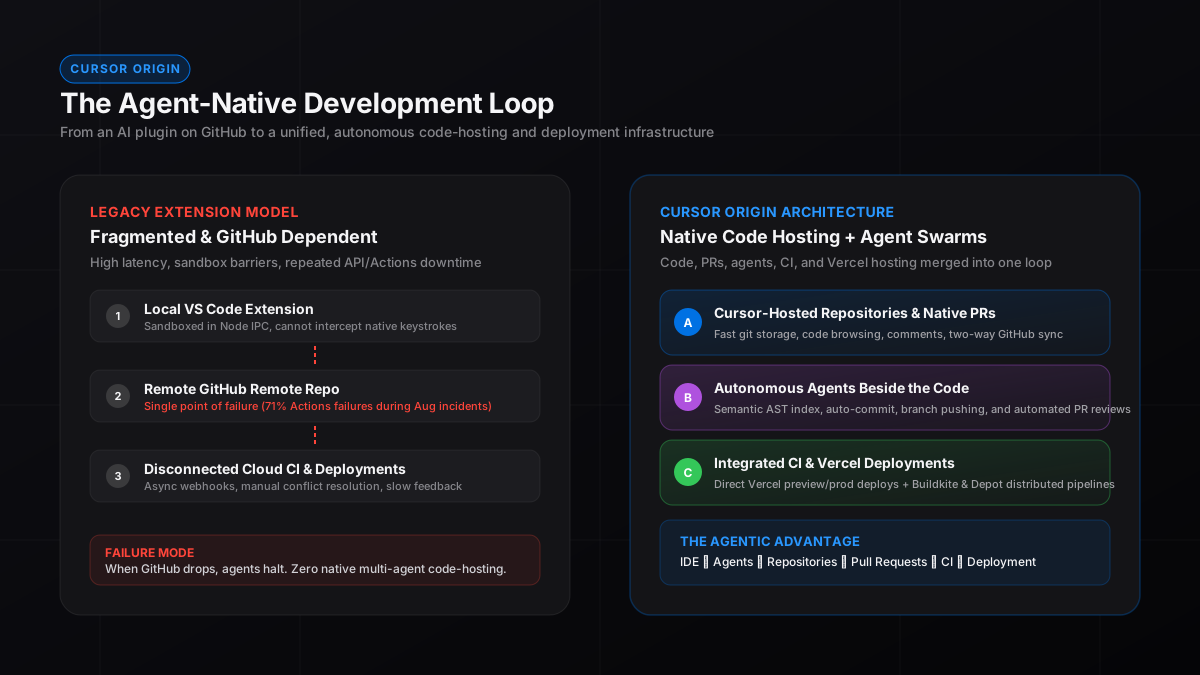
Before Origin, the developer workflow had a hard dependency boundary: CODEBLOCKPLACEHOLDER0_
When GitHub experienced infrastructure failures, that entire workflow came to an immediate halt. Throughout August 2026, GitHub faced repeated reliability disruptions: - August 6, 2026: GitHub Actions was degraded for more than 9 hours, with up to 71% of workflow runs experiencing infrastructure failures at the peak. - Mid-August Incident: Broad outages affected API requests, Actions, Git operations, Issues, Pages, Pull Requests, and Webhooks for more than 3 hours, with ~20% error rates across web/API traffic and ~50% error rates for archive and raw repository downloads.
The launch of Cursor Origin on the exact same day marked an architectural inflection point: moving code hosting directly beside the agent swarm.
Cursor Origin PlatformTL;DR
Cursor Origin is not a clone of GitHub—it is an agent-native code platform. Key capabilities live in early beta: 1. Native Repositories & Pull Requests: Full code hosting with commit graphs, checks, diffs, comments, and merging. 2. Two-Way Real-Time GitHub Sync: Push to Origin or GitHub; repositories and PRs remain synchronized without workflow lock-in. 3. Co-Located Agent Swarms: Autonomous agents run beside the remote repository, creating branches, executing refactors, and opening PRs in background compute. 4. First-Class Vercel & CI Integrations: Deploy to Vercel via Cursor Origin (which is itself hosted on Vercel) alongside Buildkite and Depot for containerized test runners.
Architectural Deep Dive: Collapsing the Developer Loop
┌────────────────────────────────────────────────────────┐
│                   1. CURSOR IDE (MONACO)               │
│  Developer edits ──► Background Shadow LSP Verification │
└───────────────────────────┬────────────────────────────┘
                            │ Real-Time AST Sync
┌───────────────────────────▼────────────────────────────┐
│              2. CURSOR ORIGIN REPOSITORY               │
│  Native Repo Hosting ──► Two-Way Bidirectional GH Sync  │
└───────────────────────────┬────────────────────────────┘
                            │ Persistent Agent Loop
┌───────────────────────────▼────────────────────────────┐
│              3. AUTONOMOUS AGENT WORKSPACE             │
│  Agents understand repo ──► Write Code ──► Open PR     │
└───────────────────────────┬────────────────────────────┘
                            │ Automated Webhooks
┌───────────────────────────▼────────────────────────────┐
│              4. CLOUD CI & VERCEL DEPLOYMENT           │
│  Buildkite & Depot CI ──► Vercel Preview & Production   │
└────────────────────────────────────────────────────────┘
1. Agents Living Beside the Code
In traditional setups, an AI assistant only sees the files currently checked out on the developer's laptop. If an agent needs to perform a large refactoring across 50 repositories, it requires 50 separate clone operations, local builds, and manual Git pushes.
In Cursor Origin, agents live directly on the hosting infrastructure: - Agents query whole-repository semantic graphs via server-side Merkle trees. - Background agents can receive an issue, formulate a plan, create a branch, run tests against Depot containers, and open a verified pull request without touching the developer's local machine.
2. Bidirectional GitHub Sync
Rather than forcing teams into an all-or-nothing migration, Cursor built a seamless two-way bridge: - Developers can sync existing GitHub repositories into Origin in one click. - Any pull request opened on Origin automatically syncs commits, comments, and review statuses back to GitHub. - If a teammate prefers reviewing on GitHub while another works in Cursor, both views remain synchronized in real time.
3. Native Vercel & CI Ecosystem
Cursor partnered directly with modern infrastructure providers: - Vercel: Deploy preview environments and production builds instantly from Cursor Origin. (Cursor Origin itself is hosted on Vercel, providing sub-millisecond edge routing). - Depot: Multi-platform Docker builds that compile up to 40x faster than standard CI runners. - Buildkite: Distributed, secure CI pipelines running on developer-controlled compute clusters.
Engineering priority scoring for agent-hosted developer platforms.
What I Would Watch Closely
Enterprise Governance and Compliance. Storing proprietary code on Cursor's servers requires SOC 2 Type II compliance, VPC peering, and enterprise SSO. Teams with strict air-gapped policies will keep GitHub Enterprise or GitLab until self-hosted Origin instances become available.
Merge Conflict Resolution at Agent Scale. When multiple autonomous agents open simultaneous PRs across shared modules, merge contention can spike. Cursor's AST-aware 3-way merge engine must prove resilient against semantic regressions.
Two-Way Sync Edge Cases. Webhook race conditions between GitHub and Origin during rapid multi-commit rebases must be monitored with idempotent queue handlers.
The Workflow I Would Use
1. Link your GitHub account and import a non-critical repository into Cursor Origin.
2. Verify that two-way sync mirrors commits and branches across both platforms.
3. Configure Vercel deployment hooks for automated preview URLs on every Origin PR.
4. Assign an autonomous agent task (e.g. @agent migrate test suite to Vitest 4) and watch the agent create a branch and open a PR directly in Origin.
5. Review the visual AST diff in Origin and merge to trigger instant Vercel production deployment.
Bottom Line
Cursor Origin marks the transition from AI as an editor plugin to AI as the foundational developer platform. By unifying repositories, pull requests, autonomous agents, CI, and Vercel deployments into one seamless loop, Cursor is constructing the post-GitHub development environment.
Sources and further reading
- Cursor Origin Platform — native repository hosting, feature specifications, and beta onboarding
- Cursor Blog: The Road to Agentic Infrastructure — architectural notes on two-way GitHub sync and server-side agent compute
- Vercel & Cursor Origin Integration — preview deployments and serverless hosting architecture
- GitHub Status Incident Archive (August 2026) — incident reports covering August 6 and mid-August API and Actions outages