
Modern feeds look magical from the outside because the final surface hides the plumbing. Underneath, a feed is a chain of retrieval, enrichment, ranking, policy, deduplication, and serving decisions. When xAI published the For You algorithm as open code, the interesting story was not "AI decides your feed." It was the pipeline becoming inspectable.
The public repository lives at xai-org/x-algorithm. The README is unusually direct: the For You feed combines in-network content (accounts you follow) with out-of-network (OON) content discovered through ML-based retrieval, then ranks candidates with Phoenix, a Grok-based transformer that predicts engagement probabilities. A May 15, 2026 repo update added a more runnable end-to-end inference path and additional content-understanding pieces—useful for education, still not a 1:1 clone of live production ops.
Reader promise: You will understand why the feed is a pipeline problem before it is a ranking-model problem—and how Phoenix fits that pipeline.
Fast Context
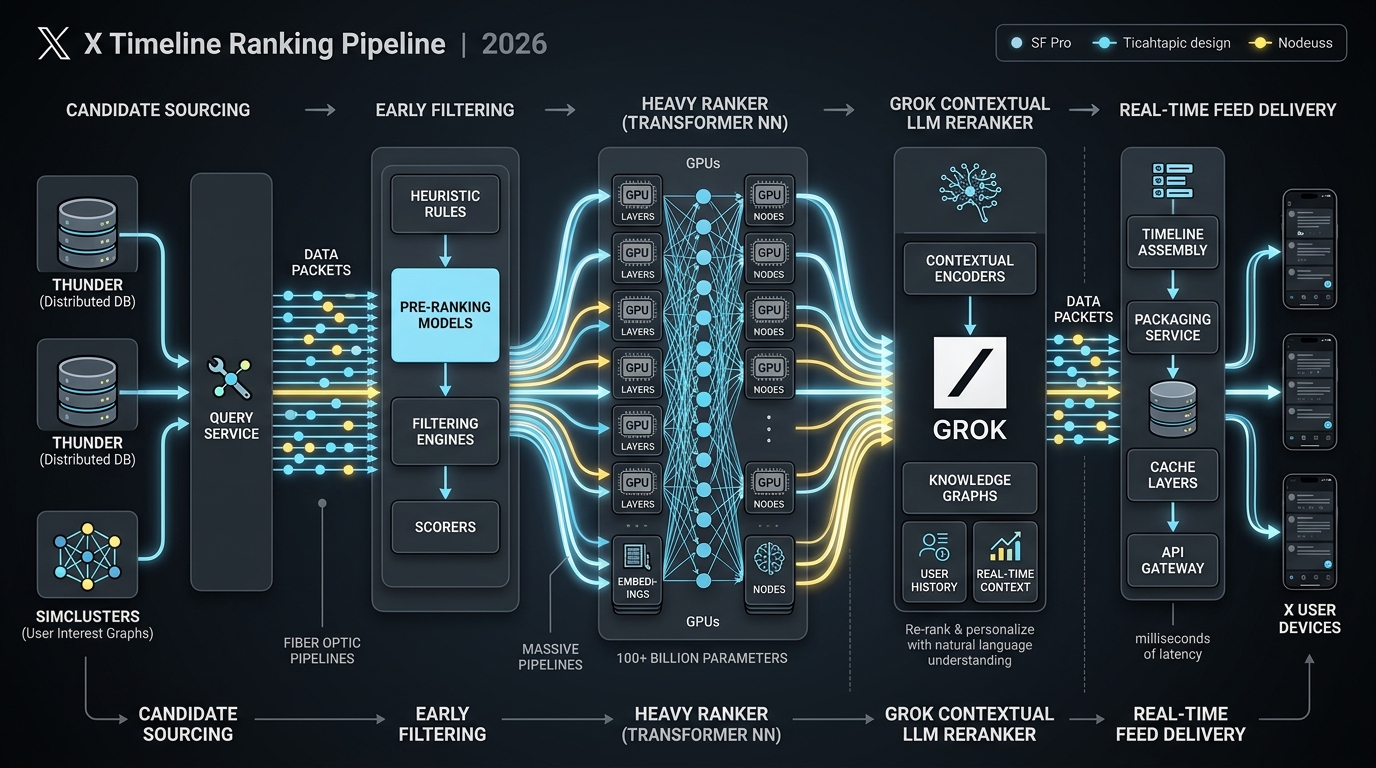
That one-sentence architecture is a systems curriculum if you take it seriously: two candidate sources, a hydration/context path, a learned ranker with multi-action heads, then filters and blending. Open code teaches the shape. Weights, live traffic, and product policy can still be closed.
TL;DR
Real-time recommendations work when many small systems cooperate. In-network retrieval keeps the graph honest. OON retrieval (Phoenix retrieval in this stack) expands discovery. Hydration turns raw post IDs into model-ready context. Phoenix ranking scores candidates with engagement-oriented predictions. Filters, blending, and product policy still decide what is allowed to ship. The model is important, but the pipeline decides what the model is allowed to see.
Pipeline Anatomy
Stage 1: Candidate retrieval
1. In-network — posts from accounts you follow. High trust, lower surprise. 2. Out-of-network — posts discovered from a global corpus via ML retrieval. Higher surprise, higher risk of irrelevance or spam.
Both matter. If you only rank the follow graph, the product becomes a following tab with better sorting. If you only push OON, the product becomes a cold discovery engine that ignores social intent. The blend is the product.
Stage 2: Hydration
Hydration is the underrated stage. A candidate ID is almost useless to a ranker until you attach author signals, engagement history, media type, language, freshness, safety context, and user state. When ranking "feels random," I check hydration completeness before I blame the transformer.
Stage 3: Phoenix ranking
Phoenix is described in-repo as a recommendation system using transformer architectures for retrieval and ranking, with sample transformer code ported from the Grok-1 open release and adapted for recommendations. The adaptation is not cosmetic: recommendation ranking needs custom input embeddings and attention patterns suited to candidate scoring, not free-form chat.
A design pattern worth stealing: candidate isolation via attention masking so candidates do not attend to each other during scoring. That makes a candidate's score independent of which other candidates share the batch—critical for caching and score consistency. I treat that as an engineering lesson, not a brand claim.
Stage 4: Policy, filters, blending
Even a great ranker should not be the final authority. Duplicate controls, safety filters, author diversity, exploration budgets, and "not interested" feedback loops are product systems. If you collapse everything into one score with no intermediate metrics, debugging becomes folklore.
A brilliant ranker cannot recover candidates retrieval never found.
What Shines in the Open Stack
- Inspectability. Teams can talk about concrete stages instead of mystique.
- Multi-source retrieval. Diversity is introduced before scoring, which is the right order.
- Grok-lineage transformers for recsys. A clear statement that hand-engineered feature museums are optional, not destiny.
- Explicit engagement multi-heads. Predicting favorites, replies, reposts, clicks, and negative actions separately, then combining them with weights, is more debuggable than a single opaque "relevance" number—as the repo itself describes.
What I Would Watch
Engagement is not value. Optimizing reply probability can surface bait. Weighted scoring needs quality, safety, and repetition controls or the system drifts toward shallow loops.
Retrieval ceiling is real. Phoenix can only reorder the set it receives. Missed candidates are invisible failures.
Open code is not open ops. Mini checkpoints and demo corpora (the repo is explicit about sample scale) are for learning. Read them as architecture education, not a production twin.
Heuristic elimination is a trade. Claims of removing hand-engineered features sound pure until you need a fast emergency filter for a spam wave. Keep an escape hatch.
The Workflow I Would Use
If I were building a portfolio search, project recommender, or content discovery surface with the same shape:
1. Retrieve from multiple sources: tags, recency, related projects, semantic similarity, manual editorial picks. 2. Hydrate each candidate with title, tags, reading time, freshness, popularity, and user history if any. 3. Score with a model or a transparent weighted function while you are small. 4. Filter duplicates, low quality, and out-of-scope items with explicit reasons. 5. Blend exploration vs exploitation with a budget you can tune. 6. Instrument each stage: recall, hydration completeness, score distribution, filter reasons, latency, and click-through.
Debug stages separately. "The feed is bad" is not a ticket. "OON recall for topic X is weak" is a ticket—once you measure it.
Things I Learned
- Ranking starts before scoring because candidate quality defines the ceiling.
- Hydrators are product-critical software, not boring ETL.
- Score independence and caching are ranking reliability features.
- A measurable pipeline is easier to improve than a single black-box function.
- Open algorithm releases are rare gifts for systems education—use them that way.
How I Would Apply This
For portfolio search and project discovery on this site:
- Retrieve from project metadata, blog tags, and semantic embeddings.
- Hydrate with summaries, tech tags, and update dates.
- Score for match + freshness + diversity.
- Explain why a result appeared ("matches WebMCP," "recent field notes," "related to ranking systems").
Explanation is the product version of observability.
xai-org/x-algorithmBottom Line
The future of feeds and assistants is not only bigger models. It is cleaner retrieval, richer context hydration, and ranking systems where every stage has a measurable job. Phoenix is interesting because it is a Grok-based ranker inside a real multi-stage pipeline—not because ranking is magic.
Sources
- github.com/xai-org/x-algorithm — For You feed algorithm overview
- phoenix/README.md — Phoenix retrieval/ranking system notes
- Prefer the repository over secondary writeups when claims conflict