
Google I/O compresses a year of platform work into inevitability theater. My job after the 2026 keynote is the opposite: name what actually changes a production architecture, and what is still a demo that needs a hardware matrix, a permission model, and a failure mode.
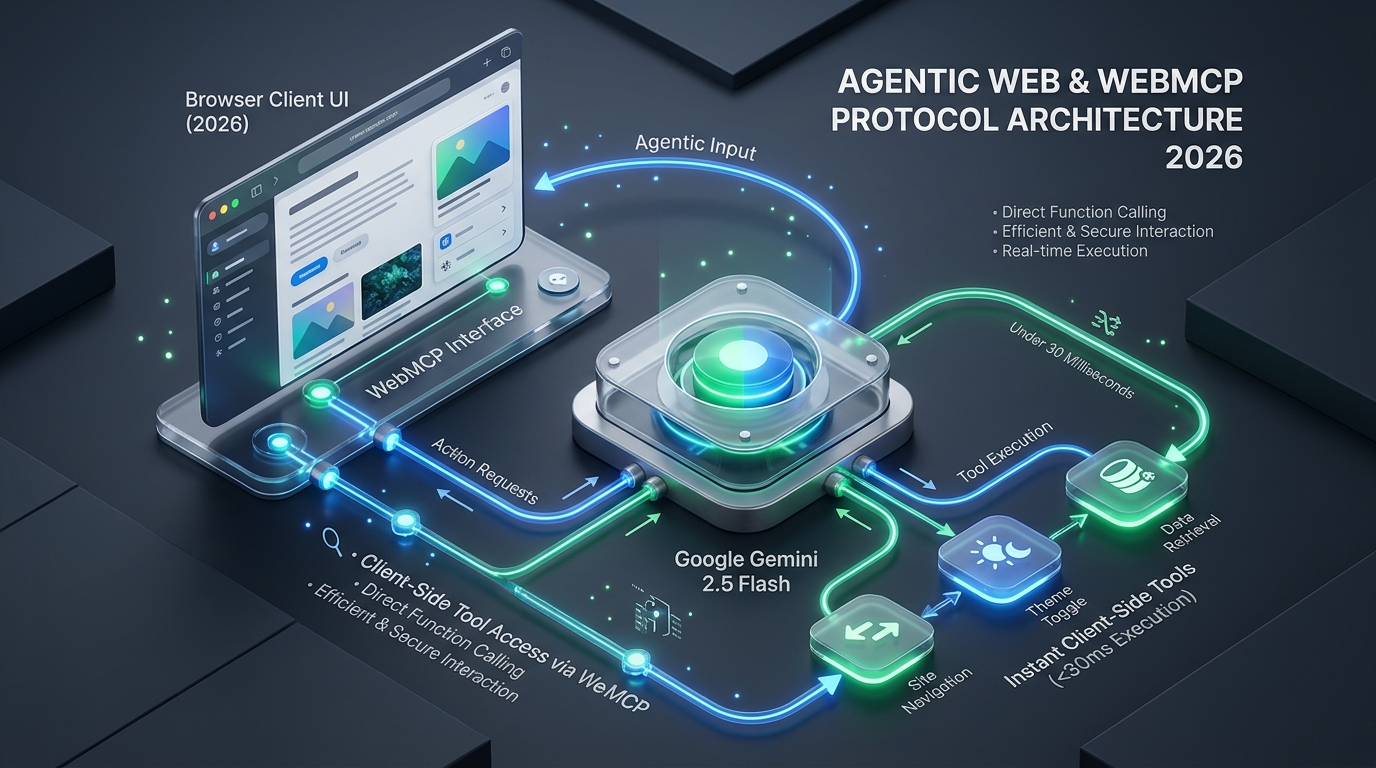
I/O 2026 centered on an agentic Gemini stack: Gemini 3.5 Flash, Google Antigravity as an agent harness, Managed Agents in the Gemini API, consumer-facing agents such as Gemini Spark, and—most relevant for web builders—WebMCP, a proposed way for sites to expose structured tools to browser agents. Gemma-family open models and browser ML paths remain part of the story, but they are not the loudest slide.
Reader promise: You will leave with a clear map for splitting AI work between browser tools, local helpers, and cloud agents—without treating the keynote as a shipping checklist.
Fast Context
The useful I/O question is not which model name won the deck. It is: where does intelligence run, what context may leave the device, and which product moments deserve an agent versus a deterministic UI?
In my read of the public announcements (May 19–20, 2026), four engineering threads matter:
1. Cloud agents with a harness — Antigravity / Managed Agents for long-horizon tool use in sandboxes. 2. Structured browser tools — WebMCP so agents call site-defined functions instead of scraping clicks. 3. On-device / built-in helpers — small local models and Prompt-style APIs for private, repeated UI work. 4. Open weights as an escape hatch — Gemma-class models when privacy, cost, or offline constraints make frontier calls the wrong default.
Vendor benchmark screenshots from the keynote are marketing. Treat them as hypotheses until you reproduce them on your tasks.
TL;DR
Design for three execution surfaces: device-side helpers for private low-latency work, browser-exposed tools (WebMCP-style) for reliable site actions, and cloud agents for hard synthesis and sandboxed tool loops. Long-context Gemini-class models make document-heavy and code-heavy products more believable when the working set is real. Gemma-style open models remain a privacy and cost valve. WebNN and WebGPU still matter for repeated local inference; WebMCP matters when you want agents to act without pretending the DOM is an API. The winning product is not a chat panel. It is a workflow where context, tools, permissions, and fallbacks are designed together.
What Actually Shines
1. WebMCP as an honest agent interface
Chrome’s I/O material frames WebMCP as a proposed open standard: sites expose structured tools (functions, forms) so browser agents can act with less brittle click-paths. Origin trials and “coming soon” Gemini-in-Chrome support are exactly the kind of detail builders should track—not keynote adjectives.
The engineering win is contract design. If your site only offers a chat box about itself, agents will invent navigation. If you expose searchProjects, createDraft, and getPricing with schemas and confirmations, agents become clients of your API surface.
2. Managed agents as infrastructure, not magic
Managed Agents (Gemini API / Antigravity harness) push the industry toward remote sandboxes: plan, call tools, edit files, browse, return artifacts. That is useful when you need isolation and a longer loop than a single chat turn.
It is also a reliability tax. You inherit permissions, retries, partial failure, spend caps, and user-visible undo. Broad tool access without success criteria is how agents become expensive chaos.
3. Local and open models as valves
Gemma-class and built-in browser models matter less as leaderboard rivals and more as escape hatches: draft polish on a private note, accessibility rewrites, offline study mode, on-page ranking. Feature-detect, degrade gracefully, and never market local AI as frontier-equivalent.
Scores are my product-fit judgment for portfolio-scale web apps, not Google’s capability claims.
What I Would Watch Closely
Device variance is still the boss. Browser support, memory, thermal limits, and battery behavior vary wildly. A Shoreline demo is not a shipping plan for mid-range Android or older Safari.
Agentic breadth is a reliability tax. Spark-style “24/7 personal agents” sound helpful until silent actions edit the wrong object. Prefer explicit confirmation for create/update/delete.
Privacy claims need a UI. Users need to see what context was used, where it ran, and what left the device. Invisible boundaries fail the first time the product guesses wrong.
Do not ship keynote benchmarks as SLOs. Google’s published coding/agent numbers are their evals under their conditions. Build a private task set.
Architecture Pattern: Three Layers, One Orchestrator
1. Edge helpers (device / browser) — rewrite, tag, rank, redact, summarize small local state. 2. Site tools (WebMCP or equivalent) — typed actions with scopes and confirmations. 3. Cloud reasoner / managed agent — multi-document synthesis, sandbox jobs, hard planning. 4. Orchestration — tool scopes, consent records, retries, audit trail, deterministic fallbacks.
Every feature declares a data boundary before it ships.
The Workflow I Would Use
1. Write the user moment first: search, summarize, draft, compare, or automate. 2. Choose the smallest execution surface that can complete the moment. 3. Prefer a structured tool over an open browser-control agent. 4. Define success criteria and failure modes before wiring a model. 5. Log tool calls, model tier, and data boundary for every request. 6. Ship a non-AI fallback that is slightly worse but always works.
For this portfolio: local-first help for search and accessibility; explicit cloud analysis when the user asks; structured actions (open project, summarize resume section) instead of a free-form super-agent.
Bottom Line
The agentic web is not about making every page talk. It is about letting web apps expose trustworthy tools, keep private work local when possible, and treat cloud agents as deliberate upgrades—not the default for every keystroke. Hybrid intelligence wins when the browser is a trusted execution surface with contracts, not a scraped marionette.
Google I/O 2026 announcementsSources and further reading
- 100 things we announced at I/O 2026 — primary announcement list
- Chrome at I/O 2026 — WebMCP and agentic web notes — WebMCP framing and origin-trial direction
- WebNN API — browser neural network acceleration (still relevant for local inference)
- WebGPU — GPU compute path used by many browser ML stacks
- Product judgments above are my read of hybrid AI architecture; treat demos and vendor benchmarks as hypotheses until validated on your hardware and task matrix.