
Google’s advantage is not one model in isolation. It is distribution across Android, Chrome, Search, Photos, Gmail, Docs, Maps, YouTube, and a growing Gemini surface area. That distribution becomes powerful only when AI helps inside the place where the user already has context.
This is an early-2026 product-architecture field note. Later I/O cycles added louder agent brands; the underlying design question did not change: where does the work already live?
Reader promise: You will see how AI becomes useful when it appears inside existing surfaces instead of demanding a separate destination.
Fast Context
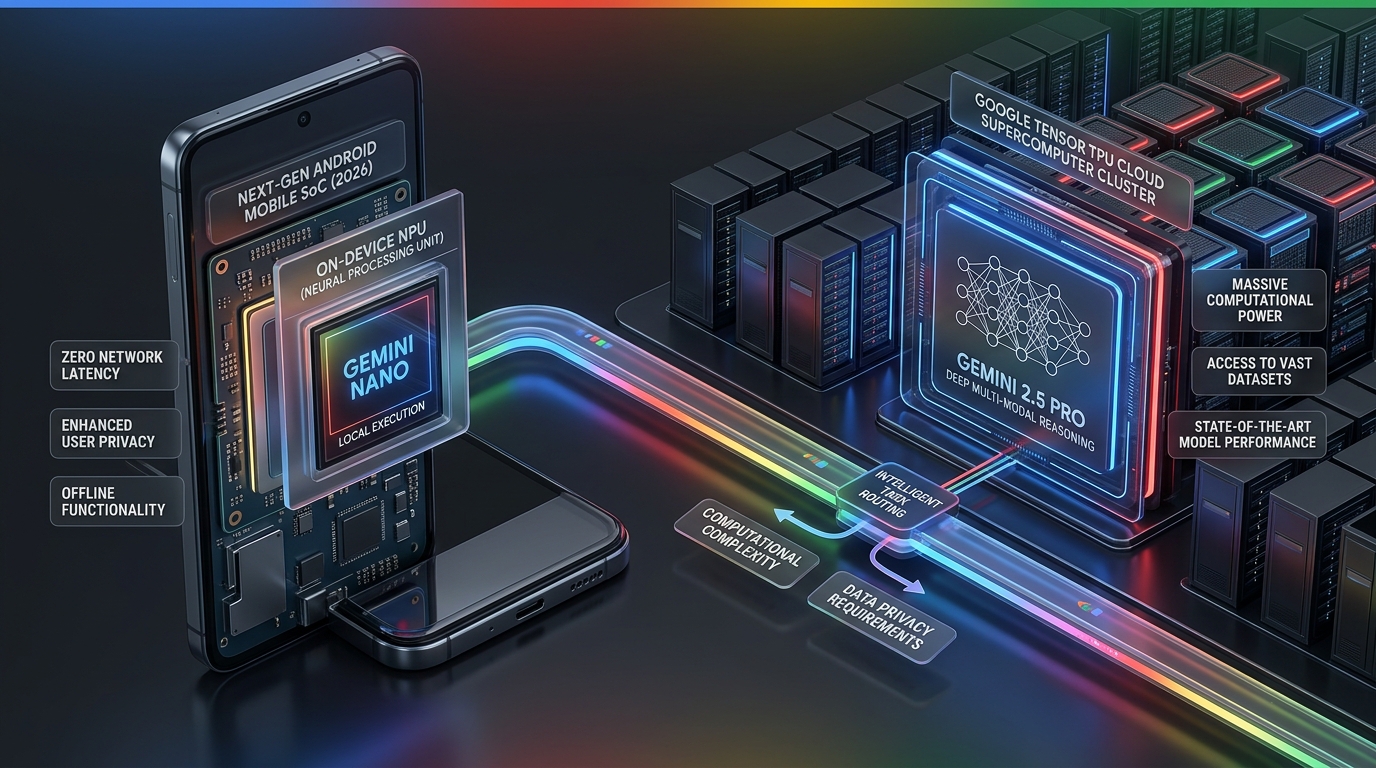
Ecosystem AI is a product strategy, not a research paper. The bet is simple: if the assistant already sits near mail, docs, photos, maps, and the phone camera, it can reduce steps without inventing a new daily destination. The hard part is making that context useful without making users feel watched, overloaded, or trapped in a maze of assistant entry points.
TL;DR
Put intelligence where user context already lives. Multimodal input (camera, voice, files, screen state, text) is the interface language. Workspace integration is where AI becomes collaboration infrastructure instead of novelty. Android is the path for device-aware features that feel native. The risks are permission opacity, assistant clutter, and reliability failures that edit the wrong object with high confidence.
What Shines
Multimodal as default input, not a demo mode
The interesting shift is not "the model can see images." It is that a user can point a camera at a whiteboard, paste a PDF, speak a constraint, and get a draft that respects all three. Multimodal products need interaction design as much as model quality: what is selected, what is excluded, and how the user corrects the system mid-stream.
Workspace as the real battleground
Summarize this doc. Rewrite this email. Extract action items from a meeting. Compare two versions of a plan. These moments matter because they sit inside existing collaboration loops. AI that edits in place beats AI that forces export-import into a chat tab.
Android as context fabric
On-device signals—locale, connectivity, battery, foreground app, accessibility settings—are product context, not telemetry trivia. Device-aware AI can change behavior: shorter answers on a noisy commute, offline drafts on a plane, larger tap targets when accessibility settings say so.
Autonomy score is intentionally low for daily consumer reliability, not research ambition. Scores are my judgment.
What I Would Watch
Permission boundaries. Cross-product intelligence without visible context controls becomes a trust problem. Users should be able to answer: what did it read, what will it change, can I undo?
Assistant sprawl. Every app adding its own floating helper creates cognitive load. Ecosystem leverage should reduce surfaces, not multiply them.
Reliability over surprise. A convenient assistant that rewrites the wrong paragraph, sends the wrong reply, or misfiles a photo loses trust faster than a slower tool that asks once.
Model routing opacity. Users do not need the model card every time, but product teams do. Know which tier handled the request when quality regresses.
Product Pattern: Context-Local AI
1. Map the feature to an existing user moment: read, write, search, compare, share, automate. 2. Limit context to the smallest set that can complete the moment. 3. Show what will happen before irreversible actions. 4. Prefer in-place edits with version history over silent rewrites. 5. Offer a one-tap "use less context" control for sensitive work.
That pattern is boring. Boring is how you ship trust.
The Workflow I Would Use
1. Moment — name the job in user language. 2. Context budget — list allowed fields and sources. 3. Action surface — button, suggestion chip, voice, or intent—not always chat. 4. Confirmation policy — auto for low risk, ask for high risk. 5. Audit — store enough metadata to debug a bad suggestion next week. 6. Fallback — deterministic UI path when AI is unavailable.
Things I Learned
- AI becomes more useful when embedded into the workflow rather than bolted onto the side.
- Multimodal is an interaction problem: selection, exclusion, and correction matter as much as perception quality.
- The best ecosystem features save steps while preserving user control.
- Distribution without restraint becomes noise.
How I Would Apply This
In my own product work, I design AI as a contextual layer: small, available, and specific to the screen the user is already using. For this portfolio that means:
- Project cards that can summarize themselves from local content.
- Search that understands "ranking systems posts" without a separate chat product.
- Contact and case-study helpers that show which fields they used.
- No second homepage for "AI mode."
Bottom Line
The winning AI ecosystems will not have the loudest assistant. They will make intelligence appear exactly where the user needs it and disappear when it does not help. Google’s distribution is the opportunity. Permission-aware, multimodal, in-place design is the work.
Sources and context
- Google AI — product and research surfaces
- Gemini — consumer/assistant entry points
- Google Workspace — collaboration-layer direction
- Ecosystem judgments are product-architecture field notes, not official Google strategy documents.