
Anthropic reasoning asks a strange but useful question: what should we infer from the fact that we are observers inside this world? It touches cosmology, simulation arguments, consciousness, and AI safety. The topic gets abstract quickly, so the practical move is to separate useful frames from speculative claims.
Naming note: "Anthropic" here primarily means anthropic reasoning / observer selection effects. It is adjacent to—but not identical with—the company Anthropic and its public safety writing. I keep company materials as optional context, not as proof of metaphysical claims.
This piece intentionally mixes philosophy and engineering. Where claims are not empirically settled, I mark them as speculation or opinion.
Reader promise: You will get a grounded way to read anthropic arguments without confusing speculation for safety work.
Fast Context
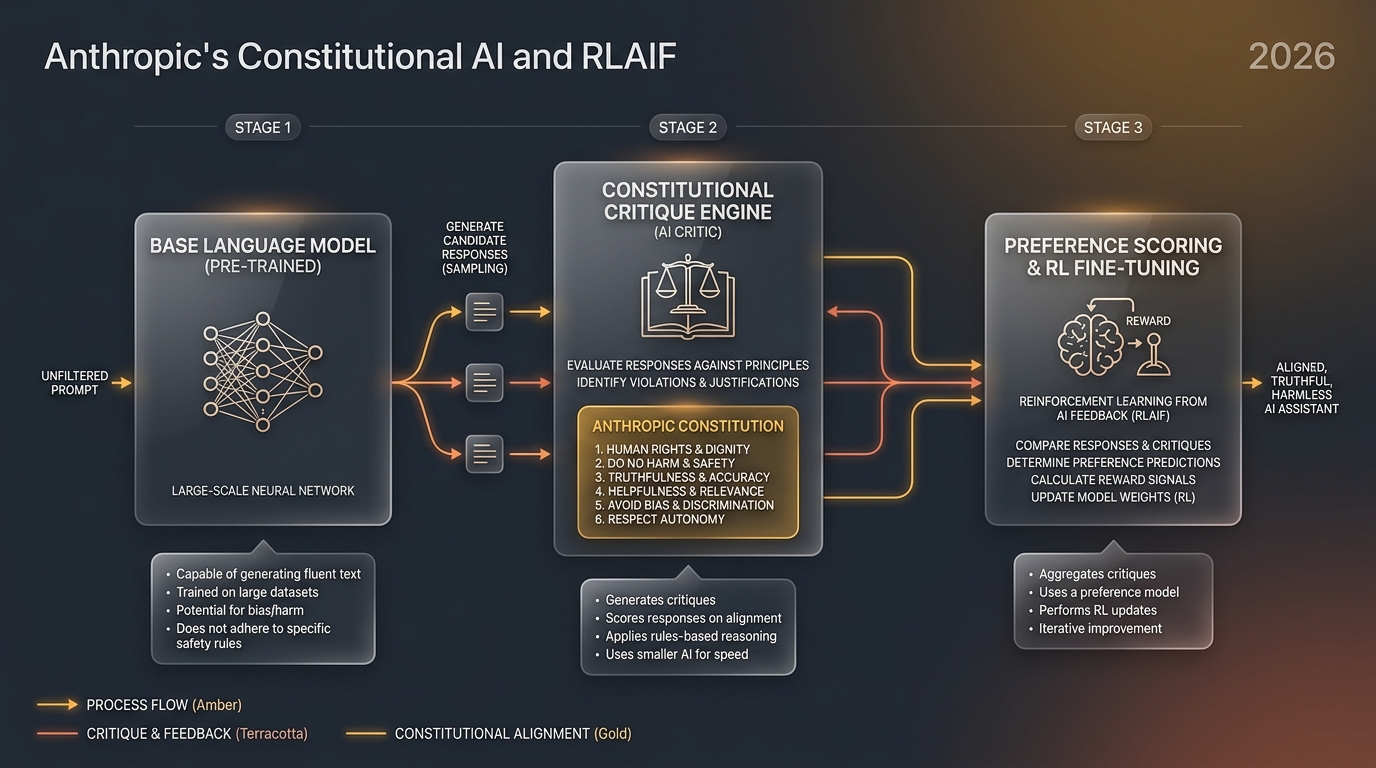
The goal is operational: can a philosophical frame change how we build, test, or govern systems? If a conversation cannot name a control, a metric, or a decision owner, it is atmosphere—not engineering.
TL;DR
Anthropic philosophy is valuable when it improves humility about assumptions. It becomes dangerous when speculation replaces engineering controls, evidence, and measurable safety work. Observer bias is real. Simulation arguments can be useful thought experiments. Consciousness claims need careful language. The bridge from philosophy to engineering is measurement: evals, red teaming, monitoring, and incident response.
Useful Frames
Observer bias
We should notice that our viewpoint is limited. Systems that look safe from a lab bench can fail in messy deployment contexts. That is an anthropic-adjacent humility: you are not sampling the full space of use.
Model uncertainty as a design input
If we are wrong about capabilities, timelines, or user behavior, products should still fail safely. Uncertainty is not an excuse for paralysis. It is a reason for reversible actions, rate limits, and monitoring.
Simulation arguments as stress tests
I treat simulation talk as a thought experiment about evidence and agency—not as a literal product requirement. The useful question is: if our assumptions about the environment are wrong, which controls still work?
Philosophy can set posture. Operations carry production risk. Scores are my judgment.
What I Would Watch
- Profound-sounding arguments that produce no measurement plan
- Consciousness claims stated with more confidence than evidence supports
- Using philosophy to avoid concrete eval work
- Collapsing "possible future risk" and "shipping bug tomorrow" into one undifferentiated panic
- Treating a company blog as settled metaphysics
The Workflow I Would Use
Translate any philosophical claim into four engineering questions:
1. What should we measure? 2. What failure should we prevent? 3. What control should exist now? 4. What uncertainty should remain visible to users?
Examples:
- Claim: "Models can be deceptively aligned." → Build evals for inconsistent tool use, add human review on high-impact actions, log trajectories.
- Claim: "Users will anthropomorphize assistants." → Design UI that avoids false personhood cues for high-stakes flows; show system limits.
- Claim: "Capability jumps are discontinuous." → Maintain kill switches, staged rollouts, and eval gates between model upgrades.
A Practical Safety Stack (Boring on Purpose)
1. Threat model — who can be harmed, how, in this product? 2. Capability evals — what can the system do in-tool, not in marketing? 3. Abuse evals — what happens under adversarial or accidental misuse? 4. Access control — tools, data, and actions with least privilege 5. Monitoring — anomaly detection on tool calls, cost, and user reports 6. Incident response — who pages, what gets disabled, how users are notified 7. Postmortem culture — update evals after every real failure
None of that requires settling metaphysics. All of it reduces harm.
Language Discipline
- Prefer "appears to" over "is conscious"
- Prefer "under these evals" over "in general"
- Prefer "could" over "will" for long-horizon claims
- Separate company brand mythos from technical claims
That discipline is not anti-wonder. It is pro-trust. Teams that talk with absolute certainty about unsettled questions often under-invest in the controls they could ship this sprint.
Things I Learned
- A good philosophical frame should change how we build, test, or govern systems.
- Uncertainty is not weakness. It is a requirement for responsible AI work.
- The bridge from philosophy to engineering is measurement.
- Humility without controls is vibes. Controls without humility become brittle checklists.
- A boring safety stack beats a poetic one when production is on the line.
How I Would Apply This
In AI product work (including portfolio assistants):
- Assume the model can surprise you
- Assume users will find edge cases
- Build review, logging, permission boundaries, and rollback paths
- Prefer structured actions over unbounded autonomy
- Keep offline or deterministic fallbacks when intelligence fails
- Write down the threat model for each AI surface, even if it is one page
That is anthropic humility as design posture—not mythology.
Anthropic research and policy writingBottom Line
The useful part of anthropic thinking is not the most dramatic theory. It is the reminder that our viewpoint is limited, and powerful AI systems should be built with that limitation in mind. Keep the mythos small. Keep the controls real.
Sources and framing
- Anthropic reasoning / observer selection as a philosophical tool (general literature)
- Anthropic — company research and safety communications for adjacent modern context only
- Speculative claims in this essay are labeled; do not treat them as empirical results