
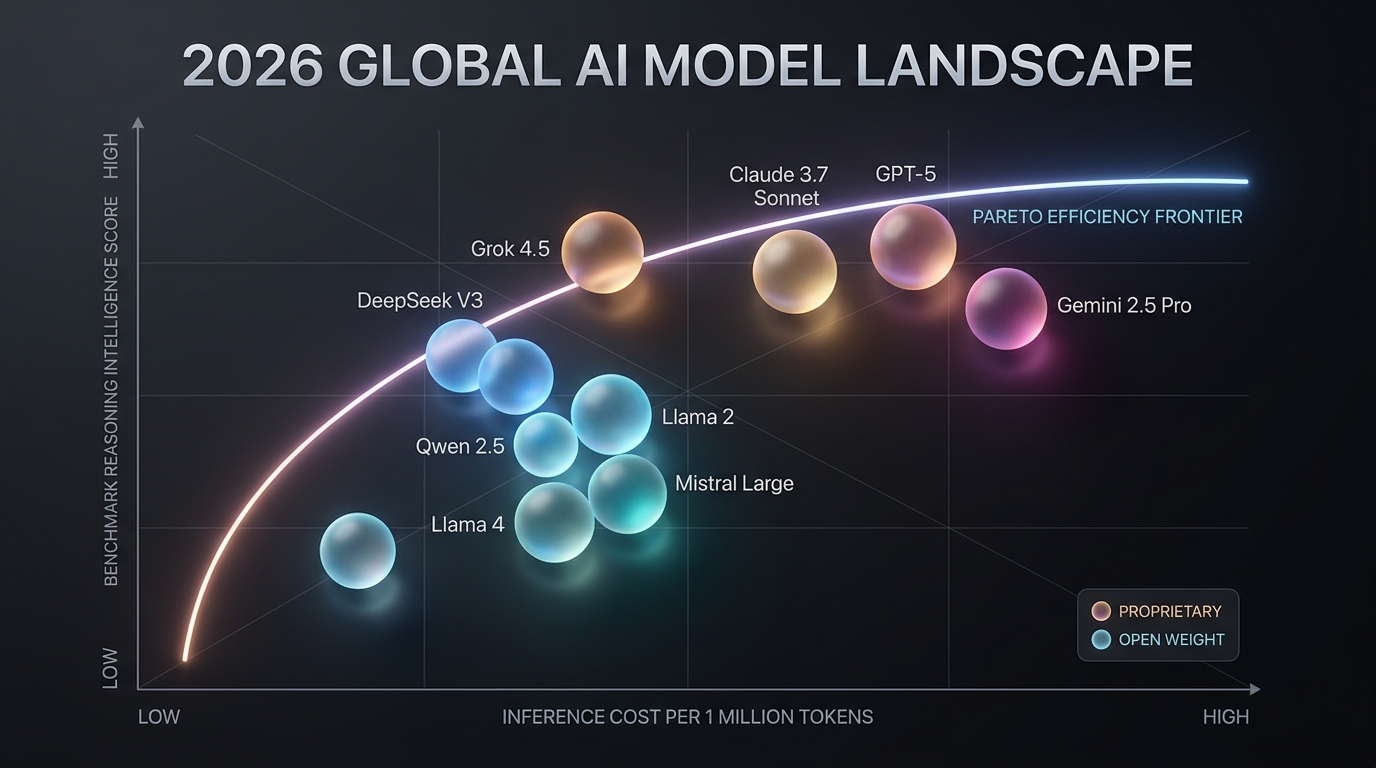
The global AI race is usually told as a leaderboard story: who tops the eval, who ships the next name, who demos the scariest agent. That story is incomplete. Model quality matters, but durable advantage also depends on compute access, energy, chip supply, data policy, research talent, deployment channels, and trust.
Reader promise: You will get a sharper lens for comparing AI ecosystems without reducing everything to model leaderboards.
Fast Context
I compare ecosystems with four lenses: research quality, compute supply, deployment channels, and governance. If one lens is missing, the strategy is incomplete even when the model demo looks strong. Countries and companies can lead on one axis and lag on another for years. I am not assigning national rankings here—those charts age badly and invite fake precision.
These bars are a template for analysis, not a claim about any specific country’s absolute score.
TL;DR
The strongest AI ecosystems combine frontier research, infrastructure, distribution, and governance. Open-weight models change bargaining power by reducing dependency on a few closed APIs. Competition accelerates reasoning, multimodal interfaces, coding tools, and agents. Benchmark chasing can hide weak reliability. Compute access is becoming a strategic constraint. The best model is not always the best system for a given product.
Lens 1: Research quality
Research quality shows up as new architectures, better data recipes, eval methodology, and the ability to turn papers into products. Leaderboards are a noisy proxy. Prefer task-specific evals that match your product: coding, long-context retrieval, multilingual support, tool use, refusal behavior.
Lens 2: Compute and energy
Training and large-scale inference need chips, networking, power, and cooling. Without that substrate, research excellence stalls at prototype scale. This is why export controls, fab capacity, and energy policy show up in AI strategy conversations even when product teams only wanted an API key.
Lens 3: Deployment channels
A model that cannot reach users is a museum piece. Mobile OS distribution, cloud marketplaces, enterprise procurement, developer tools, and consumer apps decide adoption. This is where companies with existing surfaces can convert "good model" into "default habit."
Lens 4: Governance and trust
Regulation can build trust or create friction depending on clarity and proportionality. Users and enterprises care about data residency, auditability, liability, and whether the system fails safely. Governance is not anti-innovation by default. Ambiguous governance is.
What Shines in the Competitive Landscape
- Open-weight models expand access for smaller teams, local markets, and public-sector builders.
- Competition pressures everyone on latency, price, tool use, and developer experience.
- Regional models can better match local languages, law, and cultural context when trained and evaluated intentionally.
- Productization is finally catching up to demos in coding, support, and research tools.
What I Would Watch
- Compute concentration and what it does to academic and startup access
- Eval theater that optimizes screenshots instead of production reliability
- Export and regulatory fragmentation that splits the stack into incompatible regions
- Security externalities of powerful open systems without operational guidance
- Energy realism behind "scale forever" narratives
The Workflow I Would Use
When evaluating providers for a product:
1. Define tasks and success metrics that match user outcomes. 2. Build a private eval set (not public leaderboard contamination). 3. Measure quality, latency, cost, and failure modes under load. 4. Test tool use, multilingual behavior, and refusal boundaries. 5. Require logging, data handling clarity, and exit strategy. 6. Keep an adapter layer so models remain swappable.
Open Weights as Strategy, Not Religion
Open-weight models are sometimes framed as pure ideology. I treat them as leverage:
- Lower lock-in when a closed API changes price or policy
- On-prem and air-gapped options for regulated environments
- Local experimentation loops that do not burn production budgets
- A forcing function for better evals, because you can inspect more of the stack
They are not free. You inherit serving, security patching, abuse monitoring, and quality ownership. "Open" that you cannot operate is just a download.
My product rule: keep at least one strong open-weight path in the adapter layer for non-secret features, even if production currently prefers a closed frontier model. Optionality is cheaper before the crisis than after.
What Product Teams Should Stop Optimizing For
- Winning every public leaderboard screenshot
- Shipping a new model name in marketing every quarter without user outcome lifts
- Treating geopolitics as an excuse to avoid reliability work
- Assuming regulation is either pure good or pure evil instead of reading the actual requirements
Optimize for task success, cost, latency, and recoverable failure. The rest is context.
Things I Learned
- The AI race is not one race. Research, infrastructure, product, and policy move at different speeds.
- Open-weight models change bargaining power.
- The best model is not always the best system because latency, privacy, price, and integration decide adoption.
- Strategy without measurement becomes nationalism or brand loyalty cosplay.
- Operational ownership is the hidden tax of open systems—and sometimes worth paying.
How I Would Apply This
For product engineering, I stay model-flexible:
- Adapters for providers
- Structured logging of model tier and prompt version
- Evaluation sets per feature
- Fallback paths when a provider degrades
- Cost budgets tied to user-visible value
- A documented "break glass" model swap plan tested at least once a quarter
For this portfolio chatbot architecture, that philosophy shows up as server-side routing, offline fallback intelligence when keys are absent, and no client-exposed secrets.
Stanford HAI AI Index (research landscape)Bottom Line
The global AI race will be won by ecosystems that turn model progress into reliable, affordable, governed products. Raw capability is only the first layer. Build like the leaderboard can change next month—because it will.
Sources
- Stanford HAI AI Index — research and policy trend context
- Public model cards and provider docs for any system you actually ship
- Product judgments above are engineering field notes, not geopolitical endorsements