
NVIDIA is often described as a GPU company. That frame is too small. The durable advantage is an infrastructure stack: accelerators, networking, CUDA, libraries, deployment tooling, developer habits, and a supply chain organized around AI workloads.
Reader promise: You will see why NVIDIA’s moat is the full execution path, not only the chip.
Fast Context
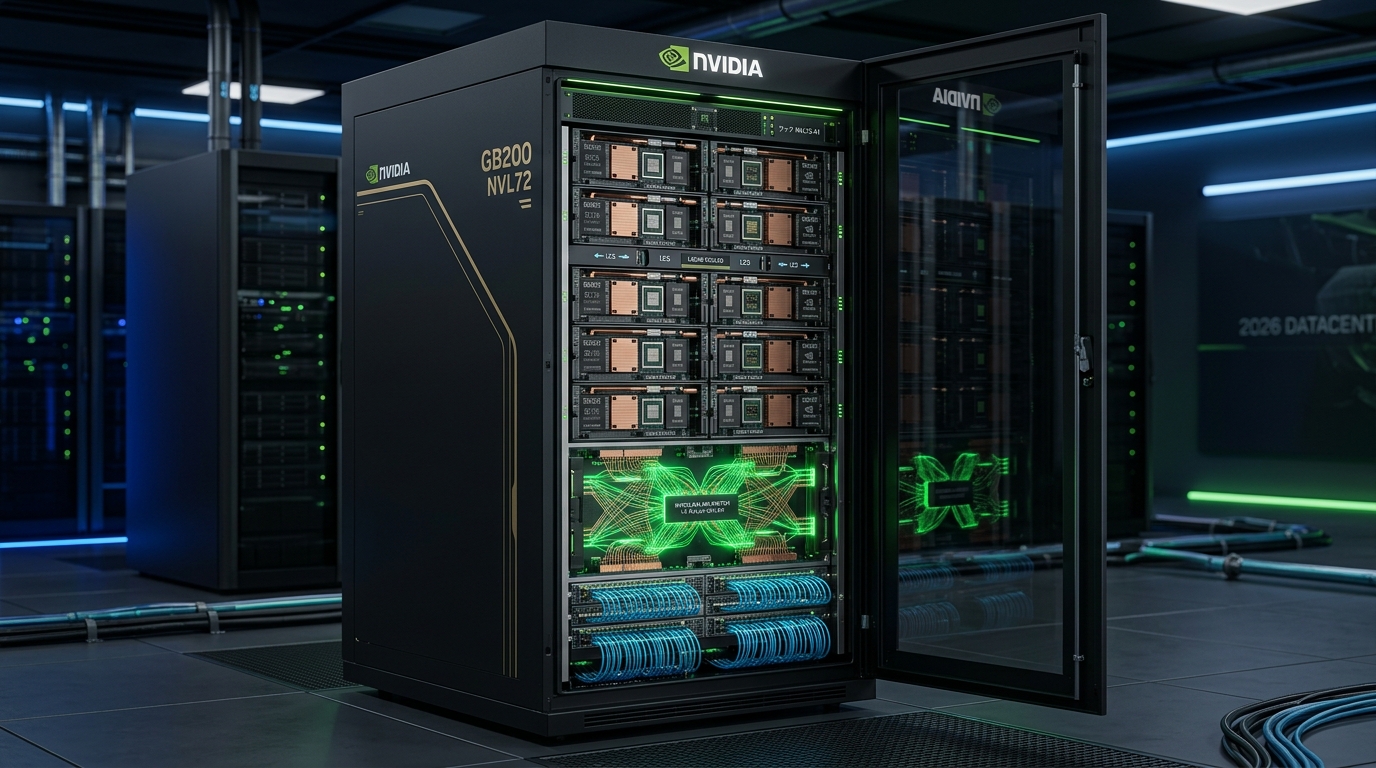
In modern AI, the product teams actually buy is not a single part number. They buy a path from research idea to trained model to served inference with acceptable latency, cost, and reliability. NVIDIA’s gravity comes from making that path the default for a decade of researchers and production engineers.
TL;DR
NVIDIA’s moat is not only faster silicon. It is the fact that the fastest path from idea to production training or inference often still runs through NVIDIA’s software and hardware ecosystem. CUDA created compounding developer advantage. Cluster-scale networking and systems design matter because frontier training is a distributed systems problem. Alternatives can win specific economics, but replacing the whole path is harder than shipping a competitive chip.
Why the Stack Beats the Spec Sheet
CUDA as cultural infrastructure
CUDA is more than an API. It is tutorials, Stack Overflow answers, research baselines, vendor libraries, hiring pipelines, and muscle memory. That kind of gravity does not disappear when a competitor publishes a FLOPS chart.
When a new accelerator asks teams to rewrite kernels, revalidate numerics, and retrain operational knowledge, the switching cost is organizational—not just technical.
Clusters, not cards
Frontier training is a networking, scheduling, storage, power, and cooling problem. Interconnect stories, multi-node orchestration, and library support for distributed training are part of the product. A great single GPU with weak cluster software loses at scale.
The full path: train → optimize → serve
Teams need a believable story for training, fine-tuning, quantization, inference serving, observability, and failure recovery. Platforms that only win one slice force customers to become systems integrators.
Scores describe competitive gravity, not a claim that alternatives cannot win niches.
What Shines
- Predictable production path for many AI workloads
- Library depth around training and inference optimization
- Developer default status in research and industry
- Systems thinking beyond a single accelerator
What I Would Watch
Cost pressure. Demand concentration prices out startups and labs. That creates political and technical appetite for alternatives even when the default stack is excellent.
Workload specialization. Some inference workloads may prefer different economics, memory hierarchies, or energy profiles. "Best training GPU" is not always "best serving TCO."
Strategic dependency. Single-stack dependency is a risk even when the stack is best-in-class. Serious orgs keep evaluation harnesses for alternatives.
Power and data center constraints. The bottleneck keeps moving: compute, HBM, networking, power, cooling, permitting, and ops talent.
The Workflow I Would Use
Plan infrastructure from product requirements backward:
1. Latency target and tail latency budget 2. Throughput and concurrency model 3. Model size, context length, and memory footprint 4. Batch behavior and cache locality 5. Observability (tokens, queue depth, GPU util, cost per request) 6. Fallback path when capacity is constrained 7. Cost envelope and scaling triggers
Hardware choice should follow that map. Buying GPUs first and inventing the product later is how budgets evaporate.
Builder Reality Check: Most Teams Are Not Training Frontier Models
A lot of discourse pretends every company is pretraining a foundation model. Most product teams are doing some mix of:
- API inference against hosted models
- Fine-tuning or adapters on smaller open models
- Embedding + retrieval pipelines
- Batch offline jobs (summarization, classification, evaluation)
- Real-time serving with tight tail-latency budgets
Those workloads still touch the NVIDIA gravity well—often through cloud instances—but the decision variables differ. For inference-heavy products, memory bandwidth, quantization support, serving stack maturity, and dollars per successful outcome can matter more than training FLOPS bragging rights.
That is why "just buy the other chip" is incomplete advice. You have to re-validate the serving stack, the kernels you actually call, the observability you already built, and the on-call runbooks your team trusts at 2 a.m.
Competition Without Magical Thinking
I want competition. Competition is how prices fall and how specialization appears. My read is that alternatives win first in niches: specific inference shapes, sovereign cloud requirements, energy-constrained deployments, or greenfield stacks without CUDA muscle memory. Displacing the entire research-to-production default is a longer game than a single launch cycle.
For builders, the practical move is not ideology. It is instrumentation. If you cannot measure cost and quality by workload class, you will make procurement decisions on vibes and social media threads.
Things I Learned
- In AI, hardware and software are inseparable.
- Developer experience can be as strong a moat as raw performance.
- The bottleneck migrates across compute, memory, networking, power, cooling, scheduling, and deployment.
- "NVIDIA dominance" is best analyzed as platform economics, not fandom or conspiracy.
- Most product teams should optimize serving economics and eval harnesses before they romanticize custom silicon.
How I Would Apply This
When designing AI systems for products:
- Treat infrastructure as part of the roadmap, not a procurement afterthought.
- Decide model choice, latency, batch size, logging, and cost controls together.
- Keep abstraction layers (serving APIs, eval harnesses) so you can re-bench accelerators without rewriting the product.
- Measure cost per successful user outcome, not cost per GPU hour alone.
- Separate training capacity planning from product inference capacity planning—they fail differently.
Bottom Line
NVIDIA’s position is strongest where it sells the full path to AI execution. The lesson for builders is clear: platforms win when they remove friction from the entire workflow, not just one layer. Respect the moat, measure your own bottlenecks, and keep just enough optionality to stay honest.
Sources
- NVIDIA Developer — CUDA and platform documentation
- Public NVIDIA architecture and data center product materials for GPU/cluster positioning
- Industry practice around distributed training and inference serving (general systems knowledge)